In Voice AI, Latency Is the New Trust Metric
Voice remains one of the most important channels in banking. It is also one of the easiest places to lose credibility.

Voice remains one of the most important channels in banking. It is also one of the easiest places to lose credibility.
Customers may tolerate a chatbot that sounds slightly robotic. They are far less forgiving of a voice assistant that hesitates. Even a brief pause between a question and a response changes the experience. The interaction stops feeling conversational and starts feeling mechanical. That shift is subtle but noticeable.
Some platforms attempt to mask latency with artificial processing sounds. That does not solve the underlying issue. It highlights it.
Modern voice AI does not operate from static scripts. It retrieves information dynamically, reasons through context, and generates responses in real time. If retrieval and orchestration are slow, the delay is audible. In banking, delay does not just feel inconvenient. It signals fragility.
Responsiveness has long been associated with competence in financial services. A teller who searches through binders to answer a routine question does not inspire confidence, even if the final answer is correct. Voice AI operates under the same expectation.
At Posh, latency is treated as infrastructure. REALM™ 2.0 compresses the speech-to-response cycle through faster retrieval-augmented generation, tighter orchestration, and improved speech recognition accuracy. The objective is straightforward: responses should feel immediate, not assembled.
Natural voice experiences depend on several components working in coordination. Speech recognition must be accurate. Retrieval must be fast. Response generation must occur without noticeable lag. When these layers are integrated within a governed system, voice interactions maintain both speed and control.
Posh Voice operates as part of the broader Agentic AI Workforce. It shares the same knowledge foundation, governance controls, and reasoning infrastructure as other AI agents. That alignment enables context retention across workflows, secure authentication flows, and direct integration with core banking systems without sacrificing responsiveness.
Voice is no longer evaluated solely by containment rates. Institutions are asking whether AI can resolve the request in a way that feels like service rather than deflection. Speed plays a central role in that perception.
In digital environments, latency has long been treated as a performance metric. In voice, it is increasingly a trust signal.
Learn how Posh Voice reduces latency while maintaining governance, accuracy, and operational control.
Blogs recommended for you
How Posh's AI Operating Procedures Redefine Banking Automation with Agentic Reasoning
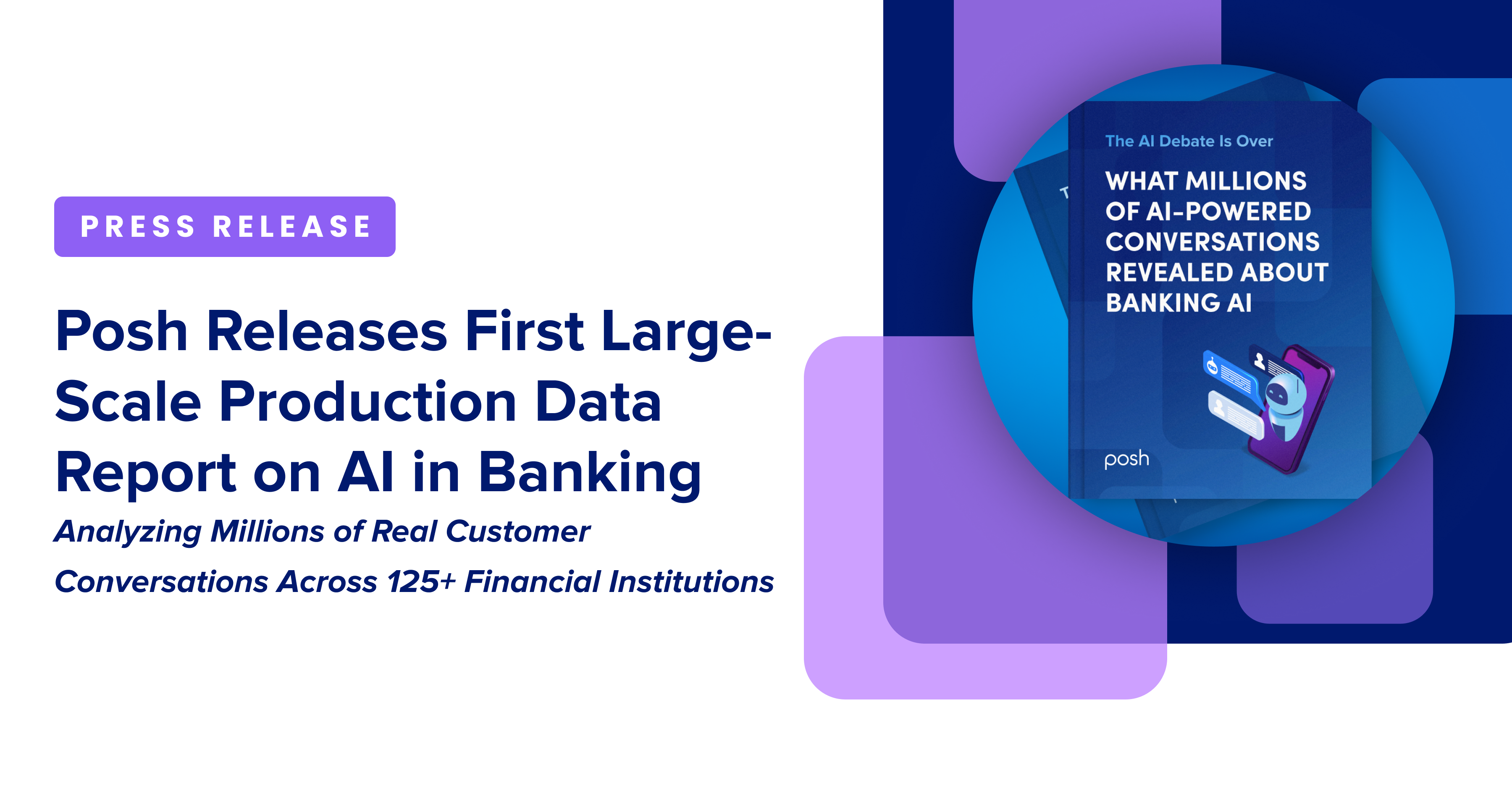
Posh Releases First Large-Scale Production Data Report on AI in Banking, Analyzing Millions of Real Customer Conversations Across 125+ Financial Institutions