
AI Products
Customer-facing
Employee-facing
Who We Help
Employee-facing
Platform
Trust & Security
Copyright ©0000 Posh AI. All Rights Reserved.

Compare AI-powered outreach to traditional campaigns. See how timing, personalization, and automation drive better results for banks and credit unions.
Most institutions know they should be doing more proactive customer outreach. The gap isn't awareness, but execution. And the reason execution breaks down almost always comes back to the same constraint: doing it well, at scale, with any consistency, is hard.
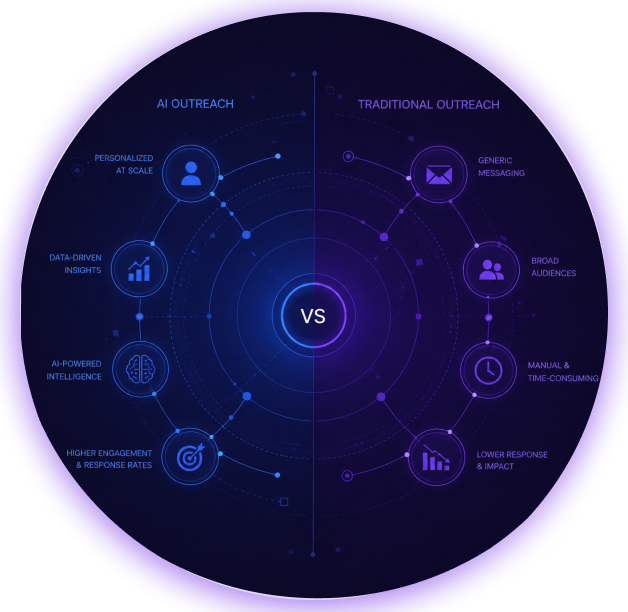
Traditional outreach campaigns were built around what was possible ten years ago: mailers, batch emails, and agents dialing through a list. AI-powered outreach is built around what customers actually need. The difference shows up in almost every dimension of how a campaign runs.

Traditional campaigns run on a schedule. A segment of customers gets an email on the first of the month because that's when the campaign was set up. The timing is driven by when the institution is ready, not when the customer needs to hear from them.
AI-powered outreach is event-driven. A loan document sits incomplete for 48 hours and a follow-up is triggered. A payment is missed and a pre-collections message is sent before the account moves to a queue. The timing is driven by what's happening in the customer's account, not what's on the marketing calendar.
Traditional outreach is segmented, not personalized. Customers in a certain product category get the same message with their name dropped in. It's better than nothing, but it doesn't feel relevant. It feels like a blast.
AI-powered outreach pulls from actual account data. The pre-approved offer reflects what the customer actually qualifies for. The indirect lending follow-up acknowledges where they are in the onboarding process. The pre-collections message reflects the specific account and timing. Customers notice the difference between a message that knows something about them and one that could have been sent to anyone.
Traditional outreach scales through headcount. That means mailers, batch emails, and agents making calls one customer at a time. More campaigns, more relationships to manage, more customers to follow up with means more staff hours. Human agents can only work through so many conversations in a day, which means the moments that don't make the priority list get missed entirely. And the ones that do get worked are only as consistent as whoever made the call that day.
AI-powered outreach doesn't have that ceiling. Every indirect loan gets an onboarding sequence. Every pre-collections window gets worked. Every customer who qualifies for a pre-approved offer gets a message before they take it somewhere else. The institution doesn't have to choose which customers to prioritize because the capacity constraint is gone.
Traditional campaigns require significant manual effort to stay compliant. TCPA opt-in verification, suppression list management, timing restrictions, and audit trails are all things someone has to own. When campaigns run infrequently, that overhead is manageable. When outreach needs to happen continuously and at scale, it becomes a bottleneck.
AI-powered outreach handles compliance logic as part of the workflow. Opt-in status is checked before anything goes out. Suppression lists are applied automatically. Timing windows are respected without someone having to manually review each send. The compliance work happens in the background so the team doesn't have to choose between moving fast and staying clean.
Traditional campaigns are measured after the fact. Open rates, response rates, and conversion data come in weeks later, get reviewed in a report, and maybe inform the next campaign. By then, the moment has passed.
AI-powered outreach is measured continuously. Response rates by message type, conversion by use case, timing performance across different customer segments. The data isn't just a report card. It's an input that makes the next outreach smarter.
Traditional outreach isn't worthless. It works well for broad awareness, brand communication, and campaigns where timing flexibility is fine. But for the moments that actually drive deposit retention, loan pipeline velocity, and relationship depth, it wasn't built for the job.
AI-powered outreach was. Not because it's newer technology, but because it matches how customers actually move through their financial lives: one account event at a time, expecting the institution to notice.
The banks and credit unions that get this right aren't running better campaigns. They're running a fundamentally different kind of outreach, one that shows up at the right moment, says something relevant, is less expensive than a traditional campaign, and doesn't require a team to manually make it happen.
Posh Introduces Outreach: Proactive AI Agents That Help Financial Institutions Capture Revenue and Enhance Service
