Agentic AI in Banking: What It Is and What It Takes to Run It
Agentic AI completes banking tasks, not just conversations. What separates a real agentic system from a relabeled chatbot, with production data from 125+ FIs.
Agentic AI in Banking: What It Is and What It Takes to Run It
Agentic AI is already handling authenticated banking work in production. Here's what separates a real agentic system from a relabeled chatbot, and the questions to ask before you buy one.
What is agentic AI in banking?
Agentic AI in banking is AI that completes tasks rather than only answering questions. It authenticates a customer, looks up an account, moves money, orders a replacement card, or books an appointment, then escalates to a person with full context when it hits its limits. A chatbot produces text. An agentic system produces outcomes, under governed permissions with an audit trail.
Four things separate agentic AI from conversational AI:
- It takes actions, not just turns. If the only output is text, the agentic framing is marketing.
- It resolves ambiguity by asking. When intent is unclear, it clarifies instead of guessing.
- It knows when to stop. Confidence drops, the interaction routes to a human with context preserved.
- Every decision is inspectable. Which path it followed, what it was permitted to do, and why.
That fourth criterion is where most of the category falls down, and it's the first thing an examiner will ask about.
Is agentic AI actually working in banks and credit unions, or is it still a pilot?
It's in production. Across 12 months of data from 125+ banks and credit unions running Posh, 25 percent of all AI conversations involve authenticated banking transactions: balances, transfers, transactions, and payments. Not informational lookups. Those conversations resolve at 71 percent, meaning handled end to end by AI or escalated to the correct team with context preserved. [The AI Debate is Over report]
Two production findings that contradict the common assumption:
Voice, not digital, carries the volume. 83 percent of AI interactions happen on voice, with an 85 percent return rate among unique users. After years of digital-first strategy, customers choose voice for transactions they care about, and they come back.
Demand concentrates hard. Across 5,905 distinct customer intents, the top 10 account for 60 percent of volume and the top 25 account for 75 percent. Automating the routine tier is a bounded, provable project, not an open-ended one.
How is agentic AI different from a chatbot or an IVR?
A traditional IVR follows a decision tree you maintain. A chatbot matches text to a scripted response. Agentic AI reasons about what the person needs, asks when it isn't sure, executes the action across your core and other systems, and hands off cleanly when it should. The practical difference is that the first two require the customer to adapt to the system, and the third adapts to the customer.
That difference is visible in the data. Containment peaks near 78 percent for interactions running one to five minutes, and drops to roughly 37 percent for interactions under 60 seconds. Fast deflection isn't resolution. A short AI interaction that turns into a longer agent call increases total effort.
What can agentic AI actually do for a financial institution?
Execute secure banking tasks. Authentication, account lookups, payments, transfers, and card replacements complete inside the conversation. Verification triggers only when the task requires it, so customers aren't authenticating to ask about branch hours.
Answer from your own material. Retrieval-augmented generation grounds responses in your documents, policies, and site content, so the AI reflects your rates rather than a general model's guess at them.
Handle real conversation. Reasoning-capable models manage natural phrasing, follow-ups, and language switching, including Spanish. Unclear intent produces a clarifying question, not a wrong route.
Cover the hours you don't staff. 27 percent of voice conversations and 35 percent of digital conversations happen between 5pm and 9am, and the top after-hours intents are balances, payments, fraud, and card replacements. Overflow and after-hours contracts become optional.
Serve employees from the same knowledge layer. The 5,905 topics customers ask are the same operational questions staff search for daily: card reissues, payments, transfers, holds, fees, loans, account changes. Unify the knowledge once and both sides improve.
Report on itself. Posh Portal surfaces performance by intent, channel, and time of day, plus content gaps and escalation patterns, so AI is managed like infrastructure rather than trusted like a black box.
Is agentic AI safe for a regulated financial institution?
Safety comes from governance, not from limiting autonomy. In Posh, every authentication path is deterministic and logged, every workflow follows pre-approved paths, and every escalation preserves an audit trail. The institution defines what the AI is permitted to do, and those controls are enforceable and reviewable.
That sits alongside documented operating procedures, escalation paths, reviews, audits, and change management. The standard isn't that the AI is trustworthy in the abstract. It's that you can prove what it did and change what it does.
Does agentic AI require new headcount or an internal AI team?
No. Configuration, integrations, and knowledge setup are handled by the vendor, not by your IT or contact center teams. Institutions go live without forming an AI team.
That distinction is worth pressing vendors on, because most institutions have heard the easy-integration claim before.
"Every vendor says there's no big IT lift, and 80 percent of them are not accurate," said Kent Nordin, Vice President of the Communication Center at 4Front Credit Union. "We got a very accurate explanation of the IT lift from Posh. We planned for the worst and hoped for the best."
Will it integrate with our core and telephony?
Integration only counts when it supports the workflows that matter: authentication paths, core banking actions, knowledge connectivity, and channel orchestration. Posh runs at production volume across 125 different tech stacks, including Jack Henry, Fiserv, and FIS cores, Cisco, Five9, and Genesys telephony, and SharePoint and Confluence for knowledge.
How do we build the business case?
Start with a conservative model on voice alone and validate it against your own call volumes and handle times.
25,000 calls per month × 70 percent resolution × 5.5 minutes × $30 per hour = $582.3K in annual baseline labor-time value, or $145.6K per quarter.
That excludes overtime multipliers, vendor premiums, shrinkage, and service-level penalties. It also excludes after-hours savings, which are upside.
The prerequisite is knowing your before-state. Institutions that capture their baseline metrics first are the ones that can prove ROI later.
Will our customers actually use it?
Production behavior says yes, and adoption isn't the constraint executives expect. The 85 percent voice return rate reflects repeat usage rather than novelty. Sensitive intents, including fraud, payments, cards, and access, sit in the top demand tier, which means customers trust AI with things that matter.
Employees follow the same pattern. In a survey of Posh Knowledge Assistant users, 79 percent saw value immediately and 76 percent said quick access makes their job easier.
Execution quality is the real variable. Accuracy, coverage, and consistency determine whether AI becomes the default entry point or shelfware.
Six questions to ask any agentic AI vendor
If a vendor can't answer all six clearly, keep looking.
- Show me institutions like mine in production today, on comparable cores and channels. Not pilots.
- What is your resolution rate across your installed base, not your demos?
- What happens to interactions that don't resolve? Context, routing, auditability.
- How do we measure performance over time and see where we stand against similar institutions?
- What controls do we keep if behavior degrades or our risk posture changes?
- How will we defend this to regulators and the board?
Posh answers all six, because AI isn't an add-on here. It's the product, operated and governed every day.
Blogs recommended for you
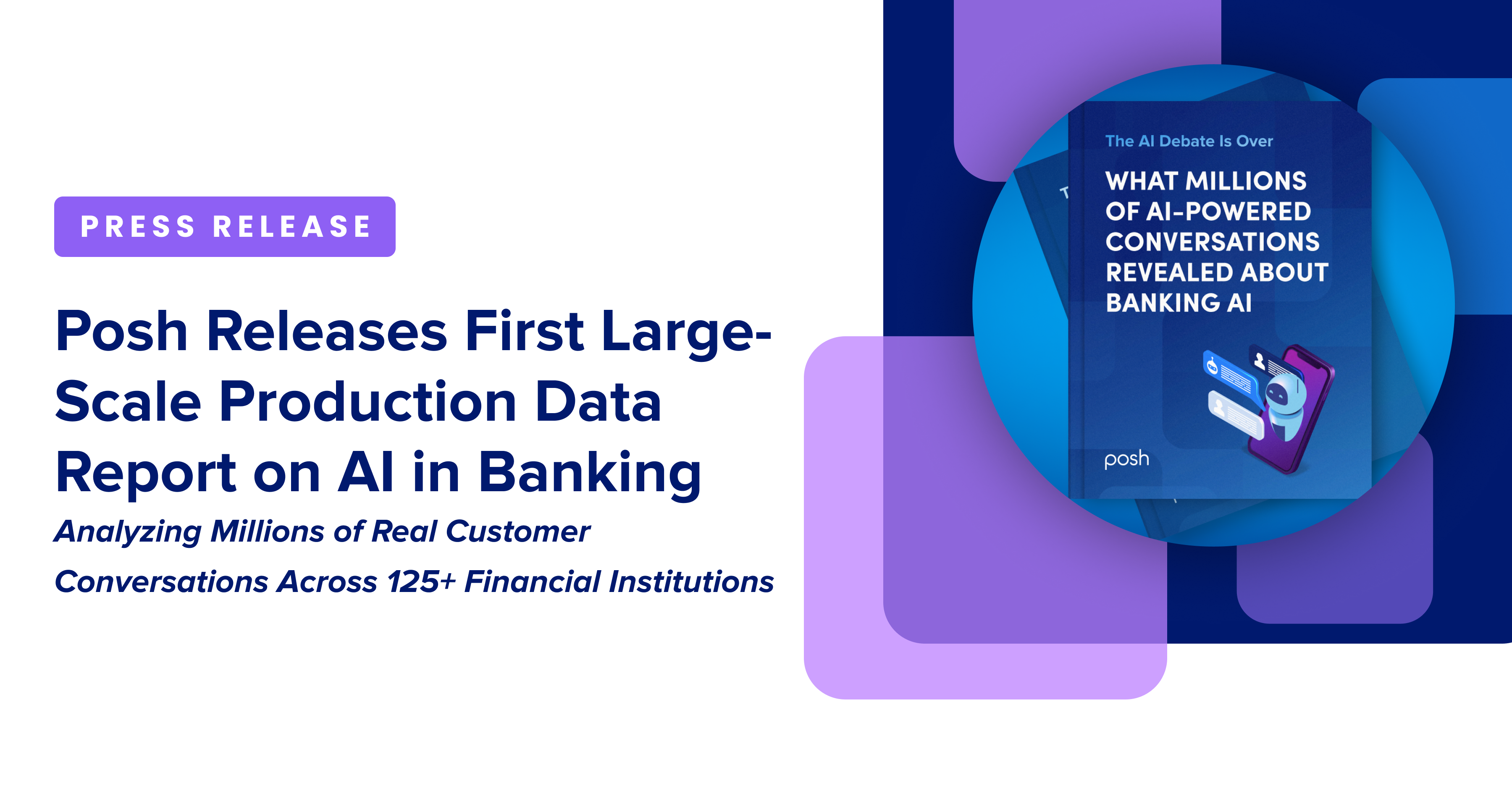
Posh Releases First Large-Scale Production Data Report on AI in Banking, Analyzing Millions of Real Customer Conversations Across 125+ Financial Institutions